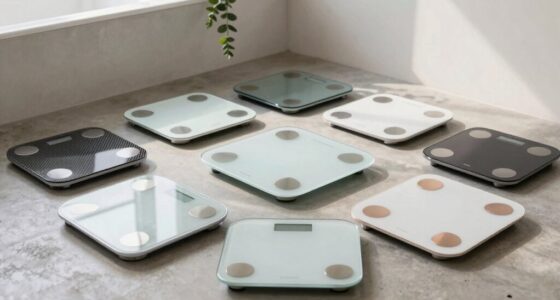
The best body composition analysis scales for 2026 go far beyond basic weight tracking — they use dual-frequency, 8-electrode BIA technology to measure 50+ metrics like visceral fat, muscle mass, bone mass, and BMR across your arms, legs, and trunk. Top picks include GE, FITINDEX, Arboleaf, RENPHO, and Etekcity models that sync with Apple Health, Google Fit, and Samsung Health. Keep exploring to find the right scale for your goals.
Quick Overview
- Prefer scales with 8-electrode dual-frequency BIA technology, as they deliver more accurate segmental readings across arms, legs, and trunk.
- Top models like RENPHO MorphoScan Nova and FITINDEX track 50+ body composition metrics, including visceral fat, metabolic age, and BMR.
- Choose scales syncing with Apple Health, Google Fit, Fitbit, Samsung Health, or MyFitnessPal for seamless health data integration.
- Leading scales support unlimited or multi-user profiles, making them ideal for households tracking multiple individuals’ body composition.
- Key safety notes apply universally: avoid use with a pacemaker or during pregnancy across all BIA-based body composition scales.
| GE Smart Digital Body Composition Scale with Bluetooth |  | Best Overall | Metrics Measured: 50 metrics | Electrode Count: 8 electrodes, dual-frequency, segmental BIA | Weight Capacity: 400 lb / 180 kg | VIEW LATEST PRICE | Read Our Analysis |
| FITINDEX Smart Body Composition Scale with 8-Electrode |  | Most User Profiles | Metrics Measured: 50+ metrics | Electrode Count: 8 electrodes, dual-frequency BIA | Weight Capacity: 400 lb / 180 kg | VIEW LATEST PRICE | Read Our Analysis |
| Arboleaf Smart Scale for Body Composition Analysis |  | Most Popular | Metrics Measured: 50+ metrics | Electrode Count: 8 electrodes, dual-frequency BIA | Weight Capacity: 400 lb / 180 kg | VIEW LATEST PRICE | Read Our Analysis |
| GE Smart Body Fat Scale with Bluetooth App Sync | Best Handheld Display | Metrics Measured: 50+ metrics | Electrode Count: 8 electrodes, segmental BIA | Weight Capacity: 400 lb / 180 kg | VIEW LATEST PRICE | Read Our Analysis | |
| GE Smart Bluetooth Body Weight & Fat Scale |  | Best On-Screen Metrics | Metrics Measured: 14 metrics (on-scale); 50+ via app | Electrode Count: 8 electrodes (implied via GE lineup; segmental BIA) | Weight Capacity: 400 lb / 180 kg | VIEW LATEST PRICE | Read Our Analysis |
| Etekcity Smart Scale for Body Weight & Fat |  | Best Smart Connectivity | Metrics Measured: 14 metrics | Electrode Count: Not specified (BIA-based with ITO coating) | Weight Capacity: Not specified | VIEW LATEST PRICE | Read Our Analysis |
| RENPHO MorphoScan Nova Smart Body Composition Scale |  | Most Accurate | Metrics Measured: 50+ metrics | Electrode Count: 8 electrodes, dual-frequency, segmental BIA | Weight Capacity: 400 lb / 180 kg | VIEW LATEST PRICE | Read Our Analysis |
| GE Smart Bluetooth Body Weight & Fat Scale |  | Best For Beginners | Metrics Measured: 14 metrics | Electrode Count: 8 electrodes (implied via GE lineup) | Weight Capacity: 400 lb / 180 kg | VIEW LATEST PRICE | Read Our Analysis |
| Arboleaf Smart Body Weight & Composition Scale |  | Best Family Scale | Metrics Measured: 50+ metrics | Electrode Count: 8 electrodes, segmental | Weight Capacity: Not specified | VIEW LATEST PRICE | Read Our Analysis |
| RENPHO Smart Body Weight Scale with BMI Analysis |  | Best Battery Life | Metrics Measured: 50+ metrics | Electrode Count: 8 electrodes, dual-frequency, segmental BIA | Weight Capacity: 400 lb / 180 kg | VIEW LATEST PRICE | Read Our Analysis |
More Details on Our Top Picks
GE Smart Digital Body Composition Scale with Bluetooth
For those seeking an all-around top performer, the GE Smart Digital Body Composition Scale with Bluetooth stands above the rest with its 8-electrode dual-frequency segmental BIA technology, measuring 50 body composition metrics across five body sections — four limbs and your torso. Its HD LED display shows seven key metrics instantly, while the free Fit Profile app tracks historical data and syncs with Apple Health, Fitbit, and Google Fit. You can support up to nine profiles, and the scale auto-recognizes you the moment you step on. It holds up to 400 lbs, but avoid use if you have a pacemaker or are pregnant.
- Metrics Measured:50 metrics
- Electrode Count:8 electrodes, dual-frequency, segmental BIA
- Weight Capacity:400 lb / 180 kg
- App Compatibility:Apple Health, Fitbit, Google Fit (via Fit Profile app)
- User Profiles:Up to 9 profiles; unlimited users
- Readout Accuracy:0.05 kg
- Additional Feature:5-section body segmentation
- Additional Feature:Instant user auto-recognition
- Additional Feature:Setup-free on-display access
FITINDEX Smart Body Composition Scale with 8-Electrode
The FITINDEX Smart Body Composition Scale suits most user profiles with its 8-electrode dual-frequency BIA technology. It tracks 50+ body composition metrics, including segmental analysis for each limb and your trunk, giving you a fuller picture than whole-body-only readings. You’ll get data on visceral fat, metabolic age, bone mass, BMR, and more. The scale holds up to 400 lbs with 0.2-pound readout accuracy and claims a 2% error margin versus medical scales. The Fitindex App supports 30+ user profiles and syncs with Apple Health, MyFitnessPal, Samsung Health, and Apple Watch, making it a solid household option.
- Metrics Measured:50+ metrics
- Electrode Count:8 electrodes, dual-frequency BIA
- Weight Capacity:400 lb / 180 kg
- App Compatibility:Apple Health, MyFitnessPal, Samsung Health, Apple Watch (via Fitindex app)
- User Profiles:30+ profiles
- Readout Accuracy:0.2 lb
- Additional Feature:2026 upgraded version
- Additional Feature:59-inch extension cable
- Additional Feature:MyFitnessPal + Apple Watch sync
Arboleaf Smart Scale for Body Composition Analysis
Arboleaf’s smart scale, among the most popular picks, suits households wanting shared body composition tracking. It supports unlimited users, stores eight profiles with auto recognition, and syncs with Apple Health, Samsung Health, Fitbit, and Health Connect. Its dual-frequency BIA with eight electrodes delivers more complete analysis than lower-body models. You’ll see seven metrics directly on the LED display — weight, BMI, body fat, muscle mass, body water, bone mass, and visceral fat — without opening the app. Dive deeper through 50+ app metrics, segmental insights, and trend charts. Don’t use it if you have a pacemaker or are pregnant.
- Metrics Measured:50+ metrics
- Electrode Count:8 electrodes, dual-frequency BIA
- Weight Capacity:400 lb / 180 kg
- App Compatibility:Apple Health, Samsung Health, Health Connect, Fitbit (via Arboleaf app)
- User Profiles:Up to 8 profiles; unlimited users
- Readout Accuracy:0.2 lb
- Additional Feature:Printable trend reports
- Additional Feature:Health Connect compatible
- Additional Feature:ABS material construction
GE Smart Body Fat Scale with Bluetooth App Sync
Serious body composition trackers will find GE’s handheld display scale hard to rival. Its retractable handle houses a 5.3-inch color display showing weight, BMI, and body fat percentage without requiring your phone. Eight-electrode segmental BIA captures over 50 metrics, including visceral fat, skeletal muscle, and body water in 10–15 seconds. The 11.8″ × 11.8″ tempered glass platform supports up to 400 lb with 0.1-pound accuracy. Through the Fit Profile app, you’ll sync unlimited user profiles to Apple Health, Google Fit, Fitbit, and Samsung Health. Note: avoid use if you have a pacemaker or are pregnant.
- Metrics Measured:50+ metrics
- Electrode Count:8 electrodes, segmental BIA
- Weight Capacity:400 lb / 180 kg
- App Compatibility:Apple Health, Google Fit, Fitbit, Samsung Health, Health Connect, Apple Watch (via Fit Profile app)
- User Profiles:Unlimited profiles
- Readout Accuracy:0.1 lb
- Additional Feature:5.3-inch color display
- Additional Feature:Retractable handle design
- Additional Feature:10–15 second stable measurement
GE Smart Bluetooth Body Weight & Fat Scale
For on-screen metrics, GE’s Smart Bluetooth Body Weight & Fat Scale leads the pack. Its 5.3-inch color screen instantly displays 14 body composition metrics, including weight, BMI, body fat, muscle mass, visceral fat, bone mass, protein, and metabolic age. You’ll get 0.1 lb readout accuracy on a 5mm tempered glass platform supporting up to 400 lbs. The free Fit Profile app connects via Bluetooth, syncs with Apple Health, Samsung Health, Fitbit, and Health Connect, and supports unlimited user profiles. You can set goals, track progress over days or years, and share trends with family members effortlessly.
- Metrics Measured:14 metrics (on-scale); 50+ via app
- Electrode Count:8 electrodes (implied via GE lineup; segmental BIA)
- Weight Capacity:400 lb / 180 kg
- App Compatibility:Apple Health, Samsung Health, Health Connect, Fitbit (via Fit Profile app)
- User Profiles:Unlimited profiles
- Readout Accuracy:0.1 lb / 0.05 kg
- Additional Feature:Goal-setting with timelines
- Additional Feature:Dynamic progress dashboards
- Additional Feature:Texas-based customer support
Etekcity Smart Scale for Body Weight & Fat
The Etekcity Smart Scale brings smart connectivity to your health tracking with seamless Wi-Fi syncing. It automatically uploads your data to the cloud for anytime access and integrates with Apple Health, Google Fit, Fitbit, MyFitnessPal, and Samsung Health through the free VeSync app. The TFT display tracks up to 9 metrics directly on-screen, while the scale measures 14 total metrics, including weight, BMI, body fat, and heart rate. You can even ask Alexa how much weight you’ve lost. Up to 5 VeSync accounts can pair simultaneously, and it requires iOS 12.0+ or Android 6.0+. It’s also FSA/HSA eligible.
- Metrics Measured:14 metrics
- Electrode Count:Not specified (BIA-based with ITO coating)
- Weight Capacity:Not specified
- App Compatibility:Apple Health, Google Fit, Fitbit, MyFitnessPal, Samsung Health (via VeSync app)
- User Profiles:Up to 5 paired accounts; multiple profiles per shared account
- Readout Accuracy:Not specified
- Additional Feature:FSA/HSA eligible product
- Additional Feature:Wi-Fi cloud auto-sync
- Additional Feature:Alexa voice control
RENPHO MorphoScan Nova Smart Body Composition Scale
Fitness enthusiasts seeking the most accurate readings will find their match in the RENPHO MorphoScan Nova. Its eight-electrode, dual-frequency BIA technology correlates to DEXA data at ≥0.98, delivering over 50 body metrics, including segmental muscle and fat analysis. The 4.3-inch TFT-LCD handle display walks you through nine pages of detailed results, while voice broadcast guides each measurement step. You’ll sync data to Apple Health, Google Fit, and MyFitnessPal through the RENPHO Health app, which supports unlimited user profiles. USB-C charging powers it for up to 150 days, and it handles weights up to 400 lbs.
- Metrics Measured:50+ metrics
- Electrode Count:8 electrodes, dual-frequency, segmental BIA
- Weight Capacity:400 lb / 180 kg
- App Compatibility:Apple Health, Google Fit, MyFitnessPal (via RENPHO Health app)
- User Profiles:Unlimited profiles
- Readout Accuracy:0.02 kg
- Additional Feature:DEXA-correlated accuracy (≥0.98)
- Additional Feature:USB-C rechargeable (150 days)
- Additional Feature:Voice broadcast step guidance
GE Smart Bluetooth Body Weight & Fat Scale
Beginners stepping into body composition tracking will find the GE Smart Bluetooth Body Weight & Fat Scale surprisingly straightforward. You’ll see weight, BMI, and body fat directly on its large LED display without needing your phone. The scale tracks 14 body composition metrics, including visceral fat, metabolic age, and BMR. Its free Fit Profile app syncs with Apple Health, Fitbit, and Google Fit, storing your historical data in detailed charts. The 5mm tempered glass platform handles up to 400 lbs, and smart recognition identifies up to eight profiles instantly. Don’t use it if you have a pacemaker or are pregnant.
- Metrics Measured:14 metrics
- Electrode Count:8 electrodes (implied via GE lineup)
- Weight Capacity:400 lb / 180 kg
- App Compatibility:Apple Health, Fitbit, Google Fit (via Fit Profile app)
- User Profiles:Up to 8 profiles; unlimited users
- Readout Accuracy:0.1 lb / 0.05 kg
- Additional Feature:White glass design
- Additional Feature:2-year warranty included
- Additional Feature:Phone-free instant results
Arboleaf Smart Body Weight & Composition Scale
Designed for families, the Arboleaf scale handles up to 8 user profiles with auto-recognition, making it a go-to choice for households tracking health together. Its 8-electrode segmental technology captures data from your arms, legs, and torso, delivering 50+ metrics more accurately than standard 4-electrode scales. The extra-large HD display rotates through 7 key metrics, so you don’t need your phone nearby. Bluetooth syncs your data to the Arboleaf app, which integrates with Apple Health, Google Fit, and Fitbit. Note: avoid this scale if you’re pregnant or have a pacemaker, as electrical currents are involved in measurement.
- Metrics Measured:50+ metrics
- Electrode Count:8 electrodes, segmental
- Weight Capacity:Not specified
- App Compatibility:Apple Health, Google Fit, Fitbit (via Arboleaf app)
- User Profiles:Up to 8 profiles with auto-recognition; guest mode
- Readout Accuracy:Not specified
- Additional Feature:Handheld + foot electrodes
- Additional Feature:Guest mode available
- Additional Feature:lb/kg/st unit switching
RENPHO Smart Body Weight Scale with BMI Analysis
The RENPHO Smart Scale’s remarkable 130-day battery life makes it ideal for serious fitness enthusiasts who want broad body composition tracking without frequent maintenance. Its eight-electrode dual-frequency BIA technology delivers results accurate within 2% of physician scales, measuring BMI, body fat, skeletal muscle, and visceral fat. The LED display shows seven-day weight trends and supports eight users, while the RENPHO Health App accommodates unlimited profiles and syncs with Apple Health, MyFitnessPal, and Samsung Health. You can print app-generated reports to customize your diet and exercise plans. It handles up to 400 lbs and carries FSA/HSA eligibility.
- Metrics Measured:50+ metrics
- Electrode Count:8 electrodes, dual-frequency, segmental BIA
- Weight Capacity:400 lb / 180 kg
- App Compatibility:Apple Health, MyFitnessPal, Samsung Health (via RENPHO Health app)
- User Profiles:Up to 8 users on display; unlimited via app
- Readout Accuracy:Not specified
- Additional Feature:7-day weight trend display
- Additional Feature:130-day battery life
- Additional Feature:FSA & HSA eligible
Factors to Consider When Choosing Body Composition Analysis Scales
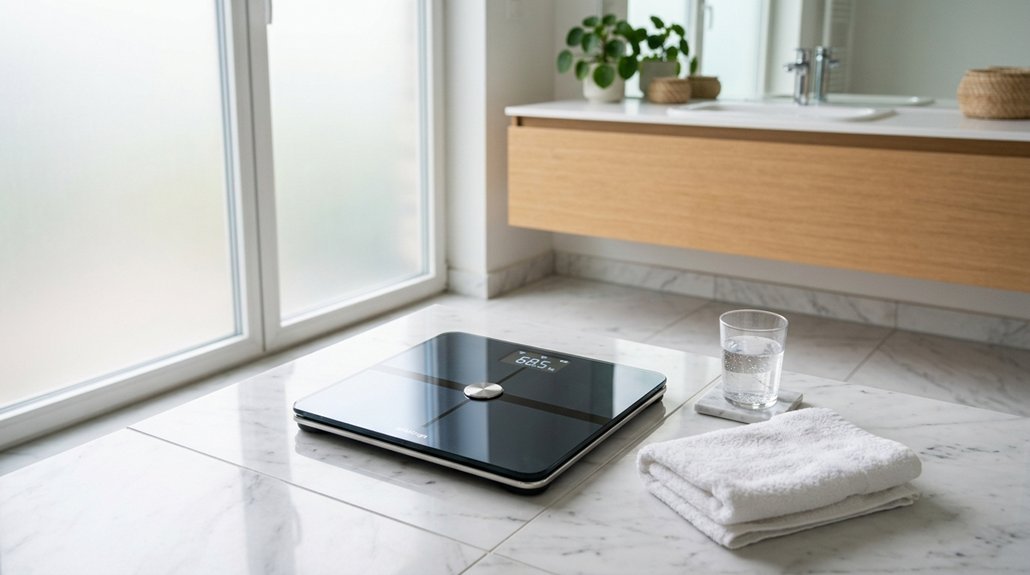
When choosing a body composition analysis scale, you’ll want to evaluate the measurement technology type, as bioelectrical impedance analysis varies in accuracy across different models. You should also consider the number of body metrics tracked, display readability, and whether the scale’s app integrates smoothly with your existing fitness platforms. Finally, if multiple people share the scale, multi-user profile support becomes a critical feature that keeps everyone’s data organized and separate.
Measurement Technology Type
Understanding how a scale measures your body composition is key to evaluating whether its readings are worth trusting. Most quality scales use bioelectrical impedance analysis (BIA), which sends electrical signals through your body to estimate fat, muscle, and water levels.
When possible, choose dual-frequency BIA, since it uses multiple frequencies to better separate water and tissue estimates than single-frequency models. Electrode count also matters—8-electrode designs typically outperform 4-electrode versions by producing segmental readings for your arms, legs, and trunk individually rather than treating your body as one uniform system.
Finally, look for scales with verified accuracy claims, such as ≤2% error compared to medical-grade scales or correlation to DEXA scans, so you know the estimates are clinically meaningful.
Number of Body Metrics
More metrics don’t automatically mean better insights—but the right set of metrics can make a significant difference. When evaluating scales, look for models measuring 50+ body composition metrics, covering visceral fat, body water, muscle mass, bone mass, protein, and BMR—not just weight.
Check whether segmental breakdowns are included, such as left/right arms, legs, and trunk, since those add real value beyond whole-body averages. Also confirm how many metrics appear on the scale itself—many devices display around 7 key metrics on-screen while revealing the full set through their app.
Don’t confuse “50 metrics” with “50 useful metrics.” Finally, prioritize scales that support longitudinal tracking with charts spanning weeks, months, and years, because a higher metric count only matters when you can spot trends over time.
Display and Readability
A scale’s display determines whether you actually use its data or ignore it. Look for a bright, on-scale screen—LED or TFT—that shows key metrics instantly without requiring you to open an app. Many scales display seven readouts simultaneously, including weight, BMI, body fat, body water, muscle mass, bone mass, and visceral fat.
Screen size matters too. Some models feature large LED panels or a 5.3-inch color display for easy viewing from a distance, while others use a 4.3-inch TFT-LCD on a handle. Prioritize displays that rotate through multiple metric pages or show a full dashboard at once. Also confirm the screen stabilizes readings within 10–15 seconds, giving you enough time to read the numbers clearly before they refresh.
App Compatibility Options
Once you can clearly read your metrics, the next question is where that data goes. Check whether the companion app syncs with your preferred health ecosystem—Apple Health, Fitbit, Google Fit, Samsung Health, and Health Connect are common options. Also verify user profile limits, since some apps support unlimited profiles while others cap storage at eight, which matters for family use.
Pay attention to integration depth too. Some platforms, like MyFitnessPal, may only receive body weight while other metrics stay locked in-app. Confirm whether the app lets you export or view historical trends across days, weeks, months, or years. Finally, make sure the sync workflow fits your setup, since Bluetooth pairing is typically required, and Wi-Fi models often need the app for firmware updates.
Multi-User Profile Support
Multi-user profile support becomes a real necessity when more than one person shares a scale. Check whether a model caps profiles at 8 or 9, or offers unlimited users through its app. You’ll also want instant user recognition, which enables the scale auto-identify whoever steps on it without manual selection, saving time during busy mornings.
Confirm how many profiles live on the device itself versus only in the companion app, since that distinction affects convenience during offline use. Verify whether the app supports separate profiles under one account or requires individual accounts per user. Finally, make sure each user’s data syncs correctly into their own health platform, since multi-user support only works well when the app’s syncing behavior keeps everyone’s metrics cleanly separated.
Weight Capacity and Accuracy
Weight capacity and accuracy both deserve careful attention before you commit to any scale. Many models support up to 400 lb (180 kg), but some list lower platform limits, so verify the maximum before purchasing. Next, compare readout precision—common options include 0.1 lb/0.05 kg, 0.2 lb, or 0.02 kg—but don’t confuse a precise readout with true body-composition accuracy, since fat, muscle, and water measurements vary more than weight does. When available, look for scales validated against medical-grade equipment with an error margin within roughly 2%. Also prioritize consistent, stable readings—ideally within 10–15 seconds—since repeatability matters more for daily tracking than any single measurement. Finally, check whether the manufacturer clearly discloses factors like foot placement that can affect results.
Safety and Contraindications
Before purchasing a body composition scale, you’ll need to understand its safety limitations and stipulations. These devices emit small electrical signals to measure body fat, which can interfere with pacemakers and other implanted electronic medical devices. If you have one, avoid bioelectrical impedance scales entirely. Similarly, don’t use them during pregnancy, regardless of whether the scale only displays routine weight and body-fat readings.
For everyone else, proper usage directly determines your safety and reading reliability. Always place the scale on a flat, stable surface, maintain consistent posture, and ensure proper electrode contact. Poor contact produces deviated results you might mistake as actual health changes. If you notice significant weight discrepancies, perform the recommended zeroing steps rather than continuing to rely on questionable data.
Frequently Asked Questions
How Accurate Are Body Composition Scales Compared to Professional Medical Equipment?
Body composition scales aren’t as accurate as professional medical equipment like DEXA scans or hydrostatic weighing. You’ll typically see a margin of error of 3-8% for body fat measurements. They use bioelectrical impedance, which can fluctuate based on your hydration levels, meal timing, and skin temperature. However, they’re still valuable for tracking trends over time. You’ll get the most reliable results by testing consistently under the same conditions.
Can Body Composition Scales Be Used Safely During Pregnancy?
You should avoid using body composition scales during pregnancy. These devices send a small electrical current through your body to measure fat and muscle, and there’s no established safety data confirming this bioelectrical impedance analysis (BIA) technology is harmless to your developing baby. Most manufacturers explicitly warn pregnant women against use. Instead, you’ll want to track your pregnancy weight with a standard scale and consult your healthcare provider for proper monitoring.
Do Body Composition Scales Work Differently for Athletes Versus Average Users?
Yes, body composition scales work differently for you as an athlete. Standard scales use population-average algorithms that often overestimate athletes’ body fat because your muscles hold more water, making you appear leaner than the algorithm expects. If you’re highly trained, look for scales with athlete-specific modes that adjust these calculations. Without this setting, you’ll likely see inaccurate readings that don’t reflect your true muscle-to-fat ratio.
How Often Should You Weigh Yourself for the Most Reliable Results?
Weigh yourself first thing in the morning, after using the bathroom and before eating or drinking anything. Do this daily or at least 3-4 times per week to spot meaningful trends. Don’t obsess over single readings—they’ll fluctuate naturally due to hydration and food intake. Instead, track your weekly averages for the most accurate picture of your progress. Consistency in timing and conditions matters more than frequency alone.
Are Body Composition Scales Safe for People With Pacemakers?
If you have a pacemaker, you should avoid using body composition scales that rely on bioelectrical impedance analysis (BIA). These scales send a small electrical current through your body, which can potentially interfere with your pacemaker’s function. You’ll want to consult your cardiologist before using one. Instead, consider safer alternatives like DEXA scans or skinfold measurements to accurately track your body composition without risking your cardiac device’s performance.
Final Thoughts
Choosing the right body composition scale doesn’t have to be overwhelming. You’ve seen the top options available, from GE’s reliable Bluetooth-enabled scales to FITINDEX’s advanced 8-electrode technology and RENPHO’s thorough BMI analysis. Consider your budget, the metrics you need, and app compatibility before making your decision. Whether you’re tracking fitness progress or monitoring overall health, there’s a perfect scale on this list that’ll meet your specific needs.