You’ll want a pico projector that balances native resolution, ANSI brightness, and battery life because those three specs determine how sharp, bright, and portable your 100‑inch‑plus viewing experience will be. Look for models with at least 1080p native resolution, 35‑60 ANSI lumens, and 1.5‑3 hours of battery to. Consider connectivity options like HDMI, USB‑C, AirPlay, or Miracast, and don’t forget contrast ratio and keystone correction for image quality. The list below ranks the top ten picks for 2026, and the details will show you why each one stands out.
Quick Overview
- Prioritize native resolution (e.g., 1920×1080) for sharpness; verify 1080p/4K claims per input method.
- Choose brightness ≥ 35 ANSI lumens for lit rooms, with contrast around 1000:1 as a secondary quality factor.
- Match screen size (60–150 inches) to recommended throw distance (1–6 ft minimum, up to ~14 ft) to avoid dimming and keystone blur.
- Verify connectivity: HDMI 2.0, USB‑A/2.0, micro‑SD, and wireless (AirPlay/Miracast) support for your devices and media formats.
- Consider portability: dimensions ~3.5‑4 in, weight ≤ 10 oz, built‑in battery and speaker, and keystone/focus features for easy setup.



More Details on Our Top Picks
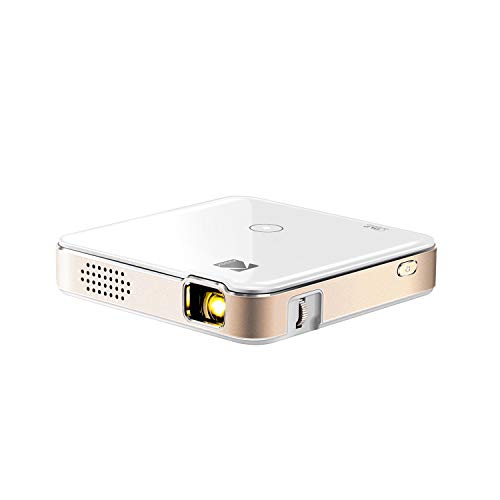
Kodak Ultra Mini Portable Projector – 1080p LED DLP HDMI USB Micro SD Built-in Speaker 100″ Display
If you need a truly pocket‑sized projector that still throws a 100‑inch image, the Kodak Ultra Mini Portable Projector (Luma 75) is the clear choice—its 35‑ANSI‑lumen LED DLP engine delivers crisp 640×360 visuals, while the built‑in battery and speaker let you set up anywhere without extra gear. You’ll appreciate its palm‑sized frame (3.46 × 3.46 × 0.91 in, 6.35 oz) and 30,000‑hour LED life, plus HDMI, USB‑2.0, and micro‑SD inputs for seamless media playback. The 1 W speaker and 3.5 mm audio jack cover sound, and vertical keystone correction eases setup. Expect up to 1.5 hours of projection on a single charge, and a 1000:1 contrast ratio ensures decent color fidelity for movies, slideshows, or gaming.
- Projection Technology:DLP
- Native Resolution:640 × 360
- Maximum Image Size:100 in
- Brightness (ANSI lumens):35 ANSI lumens
- Built‑in Speaker Power:1 W
- Connectivity Ports:HDMI, USB‑2.0, MicroSD, 3.5 mm audio
- Additional Feature:30,000‑hour lamp life
- Additional Feature:Vertical keystone correction
- Additional Feature:Pocket‑sized palm design
KODAK Luma 150 Mini Pocket Projector with Battery & Speaker
The KODAK Luma 150 Mini Pocket Projector is perfect for anyone who wants a true on‑the‑go cinema experience without lugging around a bulky system. You’ll get a DLP 0.3” EM DMD engine delivering 60 ANSI lumens, 854 × 480 resolution (up to 1080p via USB) and a 1000:1 contrast ratio, filling walls from 80 to 150 inches at a 1:2 throw. Its 1.5 W speaker and 2.5‑hour rechargeable battery let you watch movies or give presentations anywhere. Connectivity includes HDMI, micro‑USB, AirPlay, Miracast, Bluetooth, and a micro‑SD slot. The pocket‑sized unit measures 3.9 × 3.9 × 0.89 in, weighs 7.75 oz, and ships with HDMI and USB cables plus a quick‑start guide.
- Projection Technology:DLP
- Native Resolution:854 × 480
- Maximum Image Size:150 in
- Brightness (ANSI lumens):60 ANSI lumens
- Built‑in Speaker Power:1.5 W
- Connectivity Ports:HDMI, USB‑Micro‑USB, MicroSD, Bluetooth, Wi‑Fi, 3.5 mm audio
- Additional Feature:2.5‑hour battery runtime
- Additional Feature:AirPlay & Miracast support
- Additional Feature:Manual focus adjustment
Kodak Ultra Mini Portable Projector – 1080p HD 100″ Display HDMI USB Micro SD Built‑in Speaker
For anyone who needs a truly pocket‑sized cinema, the Kodak Ultra Mini Portable Projector delivers 1080p HD image quality in a palm‑sized chassis that fits in a handbag or back pocket. Its 35 ANSI‑lumens LED DLP engine projects up to a 100‑inch screen, but you’ll see the best contrast in dark or dim rooms. You connect via HDMI, USB, or Micro SD, and the 1 W built‑in speaker handles basic audio while a 3.5 mm jack lets you plug headphones. At 6.35 oz and 3.46 × 3.46 × 0.91 inches, it’s lightweight, and button controls keep operation simple. Battery life tops out at 1.5 hours, making it ideal for quick presentations or movie nights on the go.
- Projection Technology:DLP
- Native Resolution:640 × 360
- Maximum Image Size:100 in
- Brightness (ANSI lumens):35 ANSI lumens
- Built‑in Speaker Power:1 W
- Connectivity Ports:HDMI, USB, MicroSD, 3.5 mm audio
- Additional Feature:30,000‑hour lamp life
- Additional Feature:5‑foot minimum throw
- Additional Feature:Tripod mounting option
KODAK Luma 150 Mini Pocket Projector with Battery & Speaker
KODAK’s Luma 150 packs a 55‑ANSI‑lumen DLP engine, a built‑in battery, and a speaker into a 7.5‑oz pocket‑sized projector, making it perfect for anyone who wants cinema‑quality visuals on the go—whether you’re setting up a dorm‑room movie night, presenting a quick business deck, or gaming on a couch without searching for power outlets. You’ll appreciate its 3.94‑inch square body, touchpad controls, and tripod mount for stable placement. It supports 1080p input, projects up to 150 inches from 6‑8.5 ft, and offers HDMI 2.0, USB‑A, microSD, 3.5 mm aux, Wi‑Fi, Miracast, and AirPlay. Battery life and built‑in speaker let you stream movies or presentations anywhere, while the DLP engine ensures vivid colors and sharp detail.
- Projection Technology:DLP
- Native Resolution:640 × 360
- Maximum Image Size:100 in
- Brightness (ANSI lumens):35 ANSI lumens
- Built‑in Speaker Power:1 W
- Connectivity Ports:HDMI, USB, MicroSD, 3.5 mm audio
- Additional Feature:Wi‑Fi 2.4 GHz connectivity
- Additional Feature:Touchpad control interface
- Additional Feature:12‑watt power consumption
Mini LED Pico Projector for Home Theater & Mobile Devices
If you crave a portable, high‑definition cinema experience that fits in a backpack, the wepvo YG300Plus mini LED pico projector delivers 1080p HDMI, a 170‑inch image, and Bluetooth 5.4 audio, making it perfect for home‑theater nights, backyard movies, and on‑the‑go streaming. Its 1920 × 1080 LCD panel shines up to 170 inches from 1.3–5 m distance, while a 30,000‑hour LED life keeps colors vivid. Connect phones, tablets, laptops, or streaming sticks via Type‑C, HDMI, or USB, and enjoy stereo sound through built‑in speakers or Bluetooth headphones. You’ll appreciate the remote, tripod mount, and 30‑day return guarantee, all backed by a 4.2‑star rating.
- Projection Technology:LCD
- Native Resolution:1920 × 1080
- Maximum Image Size:170 in
- Brightness (ANSI lumens):400 lumens
- Built‑in Speaker Power:Stereo speaker (unspecified)
- Connectivity Ports:HDMI, Type‑C, USB‑A, MicroSD, Audio jack
- Additional Feature:Bluetooth 5.4 audio streaming
- Additional Feature:170‑inch max image
- Additional Feature:Remote control included
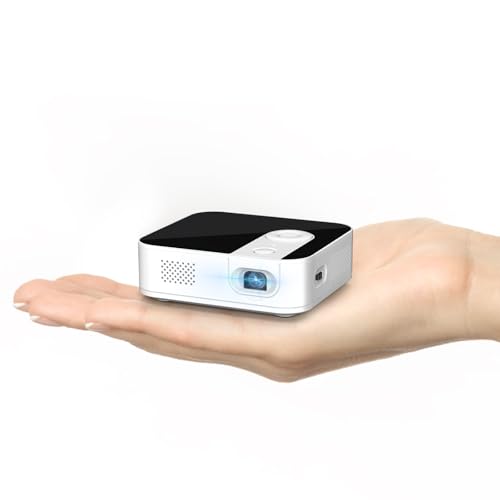
Ultra Mini Pico Pocket Projector with Battery Speaker WiFi Bluetooth
The Ultra Mini Pico Pocket Projector with Battery, Speaker, WiFi, and Bluetooth is perfect for on‑the‑go creators who need a portable, all‑in‑one display solution. At just 0.53 lb and measuring under four inches square, it fits in a backpack or attaches to a ceiling mount. Its DLP LED engine delivers native 640 × 360 resolution and upscales to 1080p, offering crisp images with reduced fuzzy edges. A 5000 mAh battery gives roughly 3.5 hours of playback, and you can extend run‑time with any power bank. You’ll enjoy 5 GHz Wi‑Fi mirroring, Bluetooth audio, HDMI, MicroSD, and USB inputs, making it compatible with phones, tablets, laptops, gaming consoles, and more.
- Projection Technology:DLP
- Native Resolution:640 × 360
- Maximum Image Size:210 in
- Brightness (ANSI lumens):320 ANSI lumens
- Built‑in Speaker Power:Stereo speaker (unspecified)
- Connectivity Ports:HDMI, USB, MicroSD, Wi‑Fi, Bluetooth, 3.5 mm audio
- Additional Feature:5 G Wi‑Fi mirroring
- Additional Feature:3.5‑hour battery life
- Additional Feature:Ceiling‑mountable design
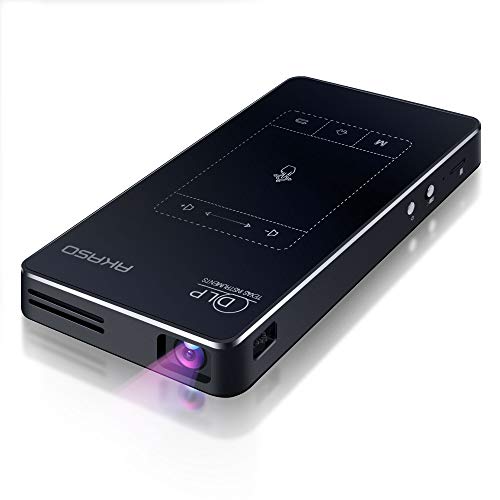
AKASO Mini Pocket DLP Projector with HDMI and Wi‑Fi
For creators who need a truly portable cinema‑grade display, the AKASO Mini Pocket DLP Projector delivers 50 ANSI lumens of bright, 1080p‑capable imagery in a device that fits in your pocket. Its 720 × 480 native resolution scales to 1920 × 1080, giving you crisp movies, slides, or games up to 150 inches from 3.3–10 feet away. You’ll appreciate the built‑in stereo speakers, 2.5‑hour battery, and lightweight 209‑gram body. Connectivity includes HDMI, Type‑C, AV, USB, micro‑SD, plus AirPlay/EZCast wireless mirroring—though copyrighted streams won’t pass through HDMI or Wi‑Fi. Remote control and tripod complete the pocket‑sized, versatile setup.
- Projection Technology:DLP
- Native Resolution:720 × 480
- Maximum Image Size:150 in
- Brightness (ANSI lumens):50 ANSI lumens
- Built‑in Speaker Power:Stereo speakers (unspecified)
- Connectivity Ports:HDMI, Type‑C, AV, MicroSD, USB, 3.5 mm audio
- Additional Feature:EZCast wireless mirroring
- Additional Feature:150‑inch max image
- Additional Feature:Included tripod stand
AKASO WT50 Mini Projector with WiFi Bluetooth Android System
Travelers and backyard movie‑night hosts will love the AKASO WT50’s blend of portability and smart features, making it a standout pick among the 10 Best Pico Projectors for 2026. You’ll carry its 0.64‑lb body and 5.71 × 3.15 × 0.79‑inch frame anywhere, then enjoy up to two hours of projection on its 5000 mAh battery. The DLP chip delivers native 1080p resolution, 50 lumens brightness, and a 1000:1 contrast ratio on images up to 120 inches. Wi‑Fi, Bluetooth, AirPlay, Miracast, HDMI, USB, and micro‑SD let you stream from phones, consoles, or laptops. Android 9 runs 3 million apps, while automatic keystone and a remote touch panel keep setup painless. A two‑year warranty and 30‑day return guarantee add peace of mind.
- Projection Technology:DLP
- Native Resolution:1920 × 1080
- Maximum Image Size:120 in
- Brightness (ANSI lumens):50 ANSI lumens
- Built‑in Speaker Power:Stereo speakers (unspecified)
- Connectivity Ports:HDMI, USB, MicroSD, Wi‑Fi, Bluetooth, 3.5 mm audio
- Additional Feature:Built‑in Android OS
- Additional Feature:Automatic keystone correction
- Additional Feature:2‑hour battery playback
Thinnest 1.81″ Smart Mini Projector with WiFi & Bluetooth
If you need a pocket‑sized projector that slips into a backpack yet still delivers true 1080p cinema, the VOPLLS Q5 is the standout choice. Its 1.81‑inch LCD panel offers native 1920 × 1080 resolution, 320 ANSI lumens brightness, and HDR10+ for deep blacks and brilliant whites. Auto‑focus and 6‑direction keystone correction get a perfect picture in under five seconds, while a built‑in gyroscope fine‑tunes alignment in real time. Wi‑Fi 6 and Bluetooth 5.2 enable wireless mirroring and audio streaming, and the 360° rotating stand lets you mount it on a tripod, ceiling, or wall. You’ll enjoy 4K playback via the dedicated app, though HDMI and USB inputs stay at 1080p. The package includes a 1.5 m HDMI cable, power cord, remote, and manual, all backed by a 30‑day Amazon return guarantee.
- Projection Technology:LCD
- Native Resolution:1920 × 1080
- Maximum Image Size:210 in
- Brightness (ANSI lumens):320 ANSI lumens
- Built‑in Speaker Power:Stereo speaker (unspecified)
- Connectivity Ports:HDMI, USB, 3.5 mm audio, Wi‑Fi, Bluetooth
- Additional Feature:HDR10+ picture enhancement
- Additional Feature:5‑second power‑on time
- Additional Feature:360° rotatable stand
Mini Portable LED LCD Projector with HDMI USB AV Remote
The Mini Portable LED LCD Projector with HDMI, USB, AV, and remote control is perfect for anyone who wants a full‑color, cinema‑style experience on the go—whether you’re setting up a backyard movie night, pitching a presentation at a campsite, or turning a hotel room into a private theater. At 11.9 × 8.6 × 4.8 cm and 0.29 kg, it slips into a backpack. It draws 5 V/2 A from a wall charger or power bank, so you’ll need an external source. Brightness hits 400 lumens, native 320 × 240, up to 1080p, and 800:1 contrast. Throw distance 1–3 m yields 24‑60‑inch images. HDMI, USB, AV, SD, audio, and Wi‑Fi options let you connect phones, consoles, laptops, or streaming sticks. A built‑in speaker and remote make it a versatile, pocket‑sized theater.
- Projection Technology:LCD
- Native Resolution:320 × 240
- Maximum Image Size:60 in
- Brightness (ANSI lumens):400 lumens
- Built‑in Speaker Power:Built‑in speaker (unspecified)
- Connectivity Ports:HDMI, USB, AV, SD, Audio, Wi‑Fi (adapter), 3.5 mm audio
- Additional Feature:No built‑in battery
- Additional Feature:400‑lumen brightness
- Additional Feature:Wall‑mount compatible design
Factors to Consider When Choosing Pico Projectors
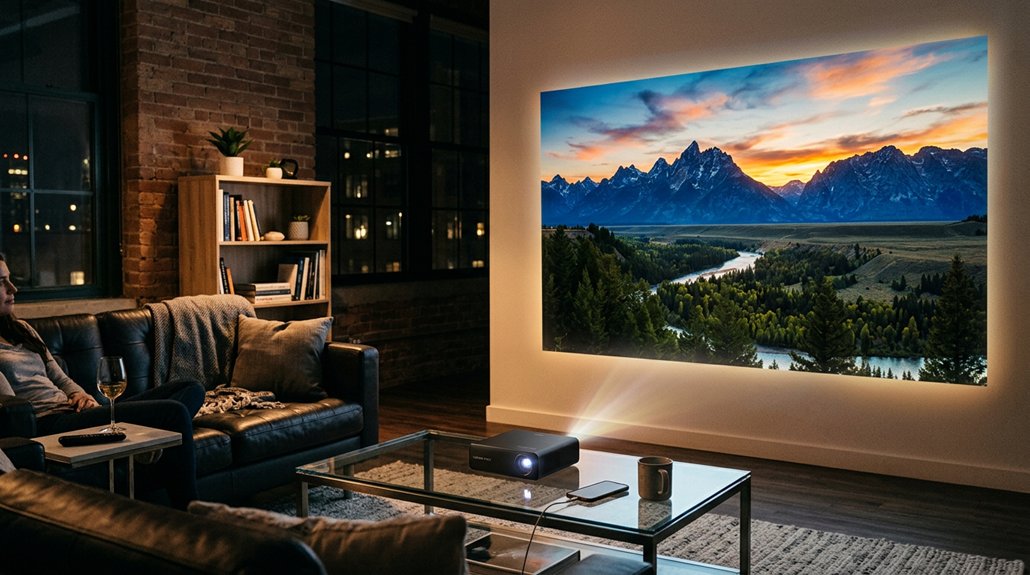
When you pick a pico projector, start by checking its resolution and brightness to make sure clear images even in lit rooms. Next, consider its portability, weight, and battery life so it fits your on‑the‑go needs without constant recharging. Finally, verify the connectivity options and native resolution scaling to match your devices and avoid unwanted image distortion.
Resolution Resolution & Brightness
While you’re weighing pico projectors, focus on native resolution and brightness because they directly dictate image clarity. Higher native resolution—whether 640×360, 854×480, 1280×720, or 1920×1080—delivers sharper text and fewer artifacts than relying on a maximum supported resolution claim. Verify that any 1080p or 4K support applies to the input method you’ll use; some units limit 4K to in‑app streaming only. Brightness, measured in ANSI lumens, typically sits between 35 and 60 for most models; more lumens let you project clearer images in brighter rooms, though pico projectors still shine in dim settings. Contrast ratio (around 1000:1) and LCD versus DLP panels affect perceived sharpness, but brightness remains the primary limiter. Match your screen size to the projector’s practical throw and luminance—smaller images usually look best within the 60‑150‑inch range most units specify.
Portability & Weight
Brightness and resolution set the visual baseline, but how easily you can lug the projector around determines whether you’ll actually use it on the go. When you compare models, look at both dimensions and weight. Pocket‑size units often sit at 3.5–4.0 inches per side and a thin 0.89–0.91 inch profile, making them slip into a jacket pocket. Ultra‑compact LCD designs can weigh as little as 0.29 kg (≈10 oz), while battery‑powered DLPs typically sit between 0.53–0.64 lb (≈8.5–10 oz). Extra features like built‑in speakers or batteries can push weight up to 6–8 oz. If you hand‑carry daily, prioritize a smaller footprint—e.g., 3.46×3.46×0.91 in—over bulkier “adapter” or ceiling‑mount styles that claim portability but feel heavier in a bag.
Battery Life & Power
If you need a projector that will actually last through a movie or presentation, start by checking the stated battery life in hours—most pico models claim 1.5 to 3.5 hours per charge. Look at the capacity; many list a 5000 mAh rechargeable pack, and some also accept power‑bank input for extended outdoor sessions. Confirm whether the unit is truly battery‑powered or relies on an external 5V/2A adapter, because a “no built‑in battery” model won’t survive a full‑day event without a wall outlet. Verify the charging voltage—most use low‑voltage 5V, which matches common chargers, but a few demand higher inputs. Finally, remember that higher brightness drains the battery faster, so prioritize models that publish realistic runtime under your intended settings.
Connectivity Options & Compatibility
How can you be sure a pico projector will actually talk to your devices? First, check the wired inputs: HDMI (usually 2.0), USB‑A/2.0, and microSD slots let you feed content straight from a phone, laptop, or memory card. For wireless, confirm AirPlay, Miracast, or other screen‑mirroring support, which typically runs on Wi‑Fi 2.4 GHz or 5 GHz; remember Bluetooth handles only audio. Verify that the listing covers Android, iOS, Windows/macOS, and gaming consoles, and note any required adapters like Lightning‑to‑HDMI or USB‑C‑to‑HDMI. Built‑in media players should accept MP4, AVI, MKV, etc., because a connection is useless if the file won’t play. Finally, be aware that many units block mirroring of copyrighted apps, so an external streaming box via HDMI may be your safest bet.
Native Resolution & Scaling
Because a pico projector’s native resolution sets the pixel count it can actually render, it directly determines how sharp your image will appear. A lower native count—like 640×360 or 854×480—will look softer even if the spec claims 1080p support, because the device must upscale. When manufacturers list a “maximum display resolution” of 1920×1080, verify whether that is a true native output or just a playback limit for certain apps. Upscaling stretches pixels, so text, edges, and fine graphics become blurry, especially after keystone correction distorts geometry. To get the crispest picture, match your source material to the projector’s native format or feed it high‑quality input. The closer the native and source resolutions, the fewer scaling artifacts you’ll see.
Contrast Ratio & Color Accuracy
Clarity in a pico projector’s image hinges on contrast ratio and color accuracy, both of which shape how vivid and lifelike the picture appears. You’ll see contrast listed as 1000:1 or similar, but higher numbers don’t guarantee deeper blacks; ambient light and the light source heavily influence perceived contrast. Look for consistent specs—if a model shows both 1000:1 and 400:1, the contrast may shift between modes or measurement methods. Color accuracy ties to claims like “16.7 million colors” and the underlying tech (DLP vs. LCD). Even strong contrast can be muted by low brightness (around 35 ANSI lumens) in well‑lit rooms, flattening blacks and colors. Treat marketing buzz such as “exceptional color accuracy” skeptically unless a measurement standard backs it up.
Throw Distance & Image Size
Throw distance directly determines the image size you can achieve, so you’ll need to measure the space between the projector and the screen before you pick a model. Most pico projectors operate within a narrow band—typically a minimum of 1–6 ft and a maximum of 5–13.8 ft. Knowing that range lets you match a unit to the room’s dimensions. Larger screens, 60–100 inches or even 120–150+ inches, usually require you to sit near the upper end of the throw range, while compact models may only fill 24–35 inches. Check the throw ratio (e.g., 1:2) to translate distance into width and height quickly. Avoid relying on heavy keystone correction; it can blur detail and dim brightness, so position the projector within its recommended throw distance for best sharpness.
Built‑In Audio & Controls
If you want seamless playback without extra gear, start by checking whether the pico projector includes a built‑in speaker—typically a modest 1.0–1.5 W driver—and whether it offers a 3.5 mm audio out for external speakers or headphones. Next, verify the audio transmission options: some units add Bluetooth for wireless headphones or speakers, while others stick to a wired AUX jack. Consider how you’ll control playback—many rely on simple push‑buttons or illuminated touch panels, but a remote can simplify navigation from a couch. In dim rooms, prioritize easy‑to‑reach controls so you can tweak volume or source without hunting through menus. Finally, match the control scheme with the audio setup: a remote plus built‑in speaker works for casual viewing, whereas onboard buttons plus an AUX output suit external sound systems.
Frequently Asked Questions
Can I Use a Pico Projector Outdoors in Bright Sunlight?
You can use a pico projector outdoors, but bright sunlight will wash out the image. Most pico projectors have low lumen ratings, so they struggle against direct sun. If you’re set on outdoor use, choose a model with at least 800–1000 lumens, position it in shade, and aim at a high‑gain screen. Even then, expect reduced contrast and limited visibility compared to indoor lighting.
Do These Projectors Support HDR Video Playback?
You’ll find that most 2026 pico projectors don’t fully support HDR video playback. Some premium models include HDR‑compatible panels and can boost contrast, but they often lack true 10‑bit color depth and the necessary peak brightness to display HDR properly. If HDR is essential, look for units that specifically list HDR10 or Dolby Vision support, and expect higher power consumption and a price premium.
What Is the Average Battery Lifespan During Continuous Use?
You’ll typically get about two to three hours of continuous playback before the battery runs out, though exact numbers vary by model and brightness setting. If you crank the lumen output to the max, expect closer to the lower end of that range; dialing it down can stretch the time a bit. Some newer units claim up to four hours with optimized power‑saving modes, but most sit around the two‑hour mark in real‑world use.
Are There Any Known Compatibility Issues With Android Phones?
You’ll find a few hiccups with Android phones. Some models only support HDMI‑C, so you’ll need a USB‑C‑to‑HDMI adapter, and certain phones don’t output 4K, limiting resolution. Bluetooth pairing can be finicky; you might have to enable “Media Audio” manually. Finally, power‑draw varies—older Android devices may struggle to supply enough current, causing flicker or shutdown during long sessions.
How Does Ambient Temperature Affect Projector Performance?
You’ll notice that higher ambient temperatures can dim the lamp, reduce contrast, and even cause overheating shutdowns. Heat also accelerates component wear, shortening lifespan. Conversely, cooler rooms keep the LED or laser stable, preserving brightness and color accuracy. If the temperature climbs above the device’s specified range, you’ll see lagging response times and possible image distortion. Keep the projector in a well‑ventilated, temperature‑controlled space for ideal performance.
Final Thoughts
Pick the pico projector that fits your screen size, brightness needs, and connectivity preferences, then enjoy crisp, portable visuals wherever you go. Whether you prioritize battery life, smart features, or pure image quality, the right compact projector can transform any space into a mini‑theater. Choose wisely, set it up, and let the big‑screen experience follow you.